EquiOps
EquiOps turns school nutrition operations into a decision system by linking attendance, FRL, participation, labor, and reimbursement signals in one district-wide operating view.
What EquiOps set out to fix
A decision layer for district nutrition operations
District nutrition teams were operating across attendance exports, FRL eligibility records, point-of-sale meal data, labor schedules, and reimbursement workflows that rarely spoke the same language. Leaders could inspect each system in isolation, but they still could not see cross-functional cause and effect quickly enough to act with confidence.
The real issue was not the absence of data. It was the absence of one operating model that connected participation, labor, reimbursement, and student eligibility into a single decision surface. Without that layer, district teams were forced into reactive management and post-hoc explanation instead of timely intervention.
EquiOps was built as a decision system rather than a reporting layer. The platform unified attendance, FRL, participation, labor, and reimbursement signals so district leaders could move from fragmented reporting to operational diagnosis, prioritization, and scenario-backed action.
The operational problem was not a lack of data
Districts already had reporting systems, but the data was fragmented across tools, teams, and reporting cadences. That fragmentation delayed diagnosis, broke the connection between operational and financial decisions, and made high-confidence intervention difficult.
No diagnostic visibility
Teams could see that participation had changed, but not why. Attendance, eligibility, meal counts, and site-specific conditions lived in separate views, so diagnosing a performance issue required manual reconciliation and too much guesswork.
Disconnected labor scheduling
Labor planning often happened on a separate track from real demand signals. That meant sites could be overstaffed relative to meal volume in one location and still experience throughput pressure in another.
Reactive reimbursement
Reimbursement gaps were usually discovered after claims cycles and spreadsheet reviews, not while operators still had time to intervene. By the time issues surfaced, recovery paths were narrower and harder to operationalize.
Siloed data systems
Student information, FRL status, participation, labor, and finance data were each locally useful but globally disconnected. The organization had systems of record, but not a system of operational truth.
Hidden equity gaps
When participation drops are only visible at the aggregate level, site- and segment-level disparities stay hidden. That makes it hard to identify where operational friction is disproportionately affecting the students the program is supposed to serve best.
What a delayed decision looked like
A district could see that meal participation at a site was soft, but not whether the real driver was attendance patterns, FRL mix, line-speed friction, staffing mismatch, or reimbursement capture leakage. By the time teams manually pieced those signals together, the intervention window was already compromised and the financial impact had become harder to recover.
How the product worked in practice
Each workspace was designed to answer a specific operational question, not just display another dashboard. The system moved from district overview to diagnostic drill-downs and then into modeled intervention choices.
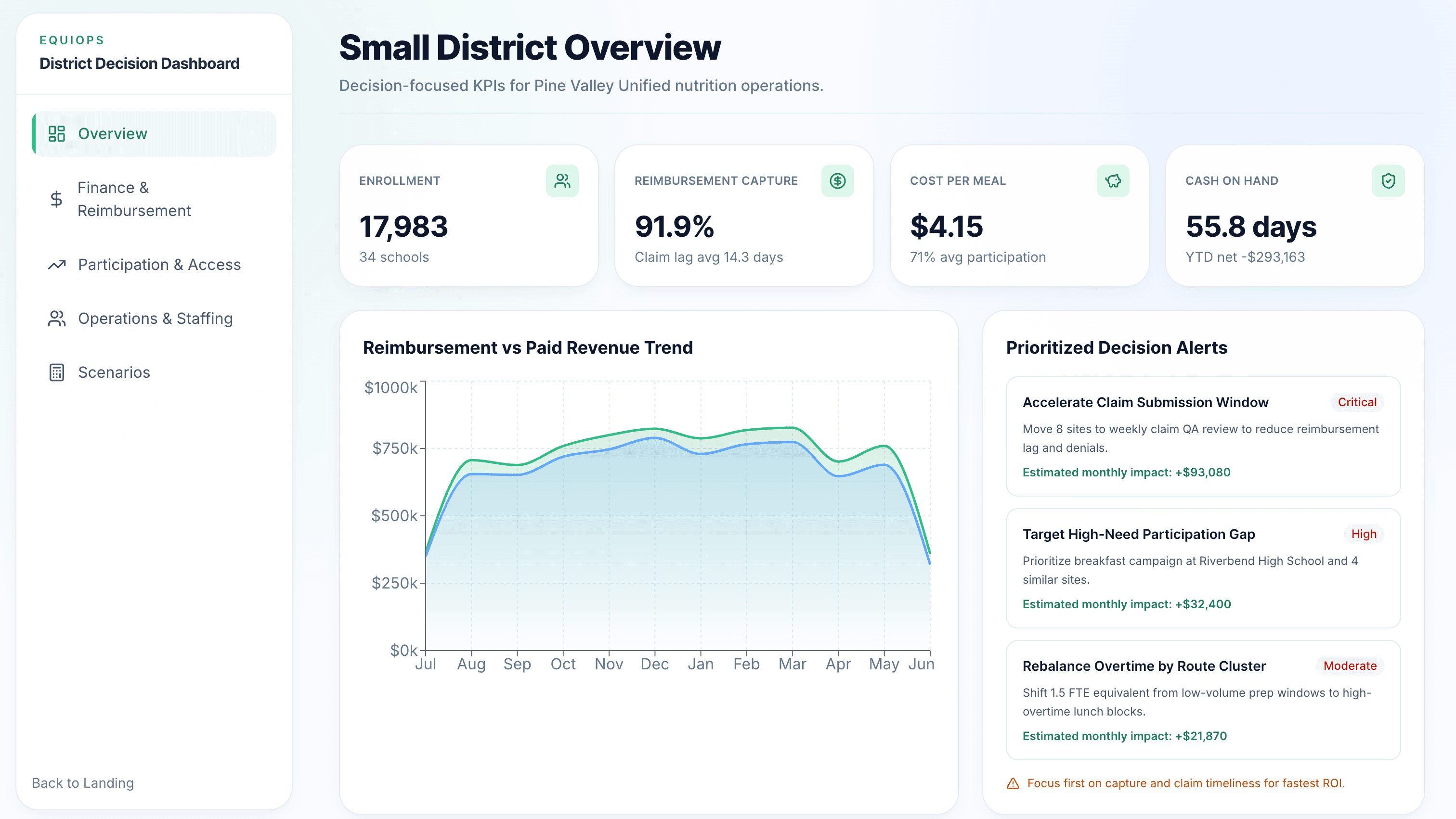
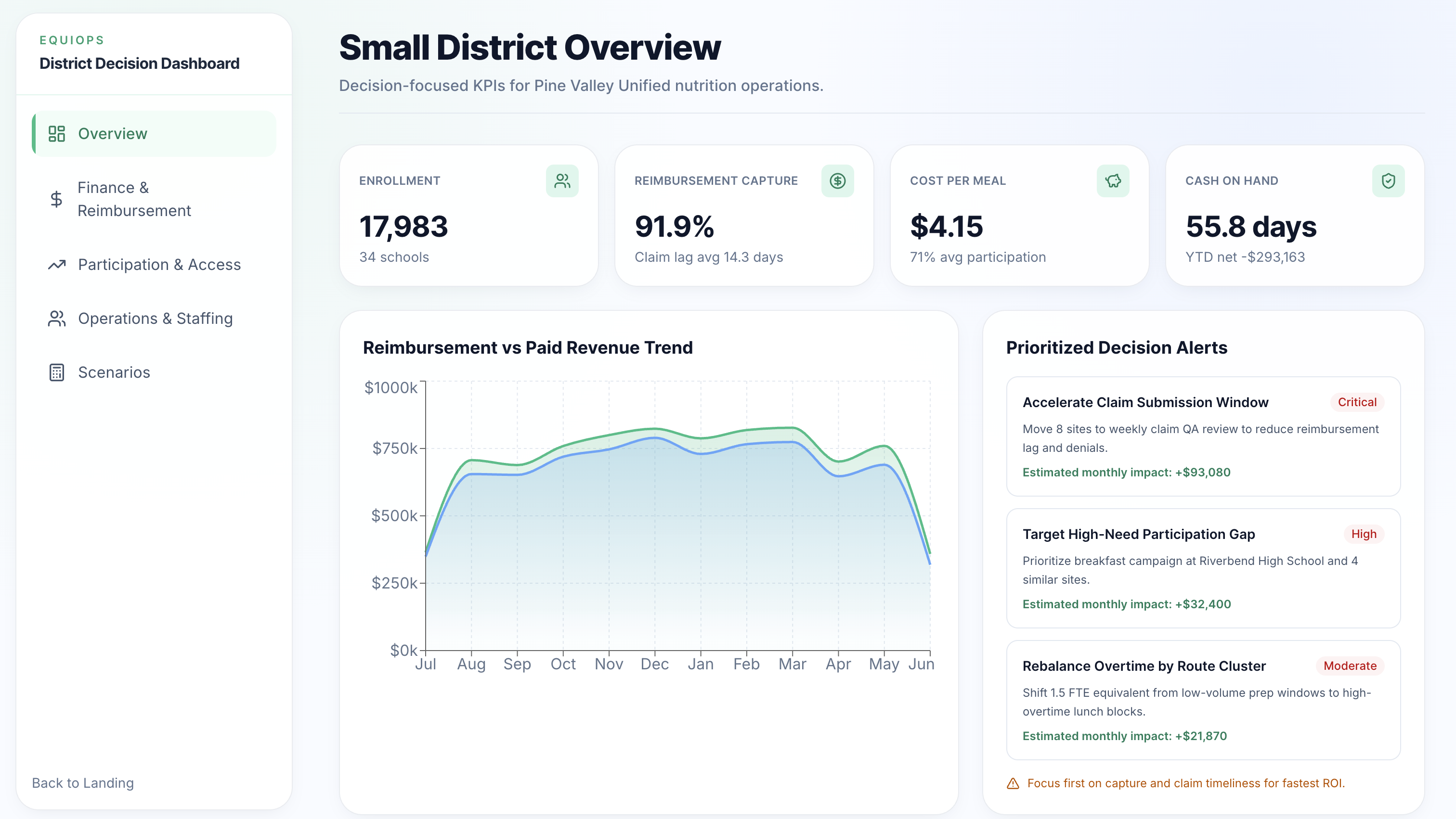
District overview
A district operating snapshot that pulls enrollment, participation, capture, and time-to-action into one executive-readable frame.
Participation analysis
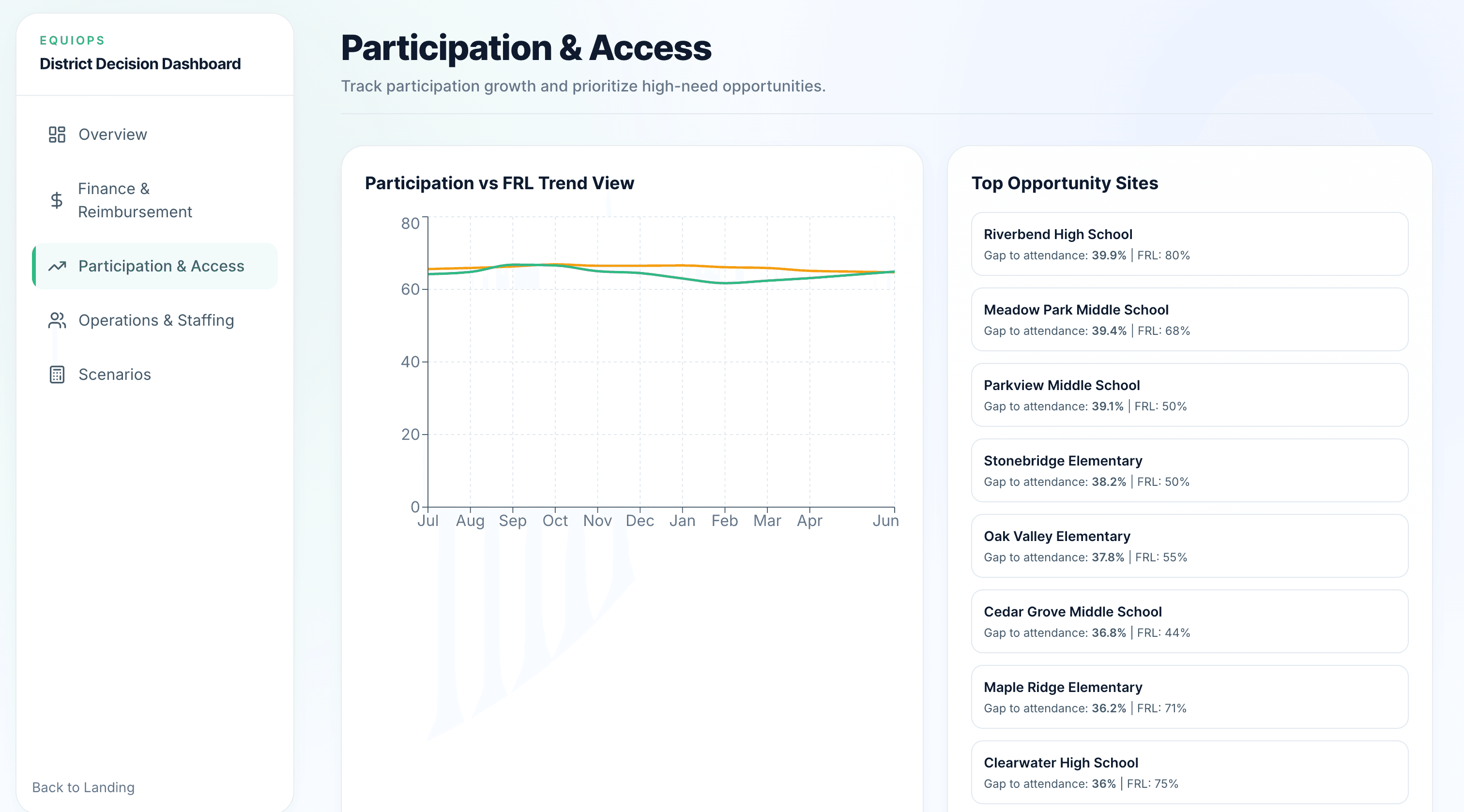
A participation workspace built to show where meal uptake lags attendance and which sites or student segments require intervention.
Operations and labor view
An operations surface that maps staffing pressure against actual demand and site variability instead of relying on static assumptions.
Scenario planning
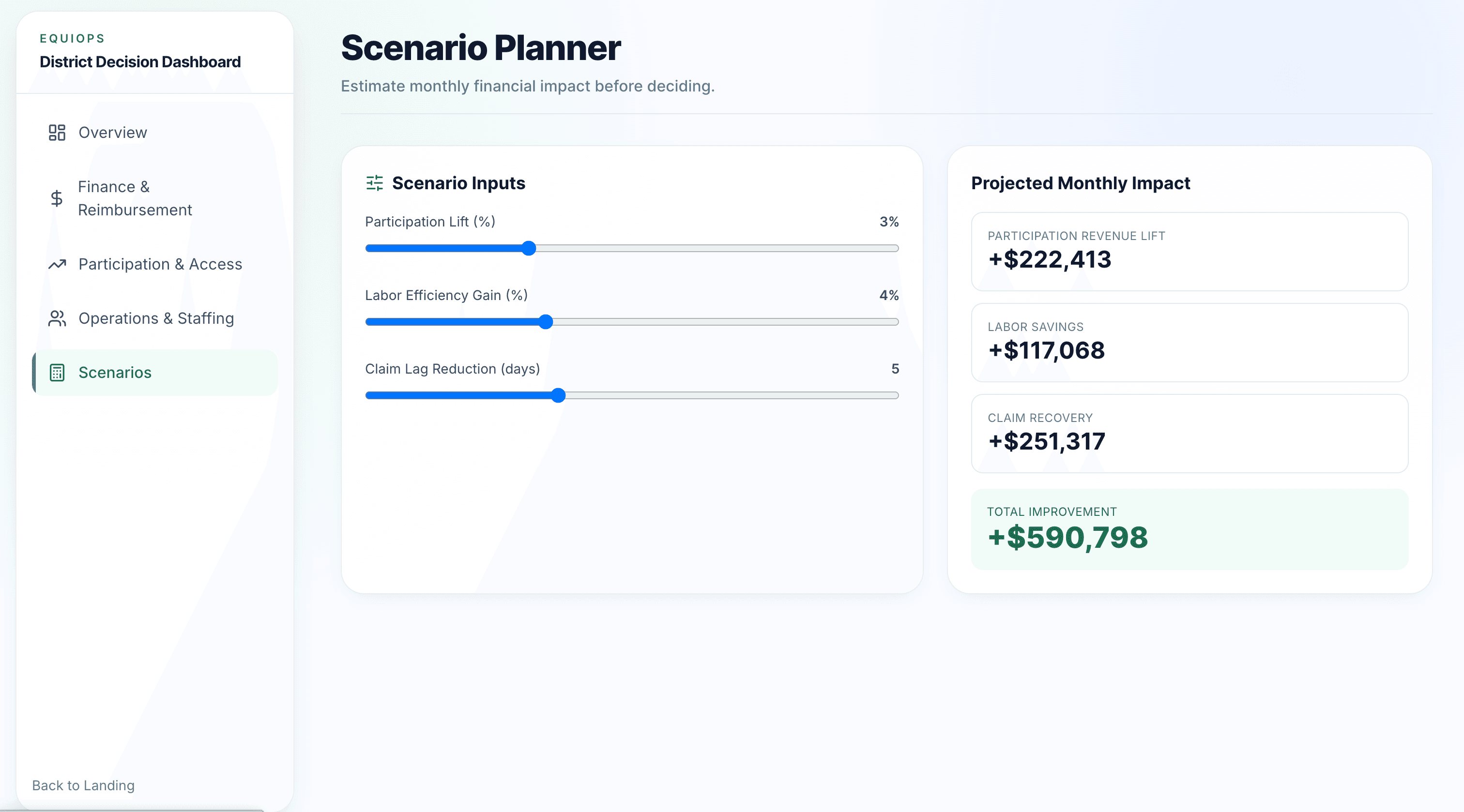
A scenario engine that models interventions before rollout and ties participation lift, labor savings, and claim recovery into one decision surface.
Three decisions the platform made easier
Participation Gap Recovery
District teams could identify that participation was soft, but they could not isolate whether the issue was concentrated in a few sites, linked to attendance patterns, or tied to a specific student segment without a slow manual review.
EquiOps surfaced site-level participation against enrollment and attendance context, making it clear where demand conversion was failing and which cohorts were being missed.
Operators could prioritize specific sites and segments for intervention instead of deploying generalized district-wide changes with weak targeting.
Reimbursement Leakage Control
Claim and capture issues were often treated as back-office cleanup because the upstream causes were not visible in time for operations teams to respond.
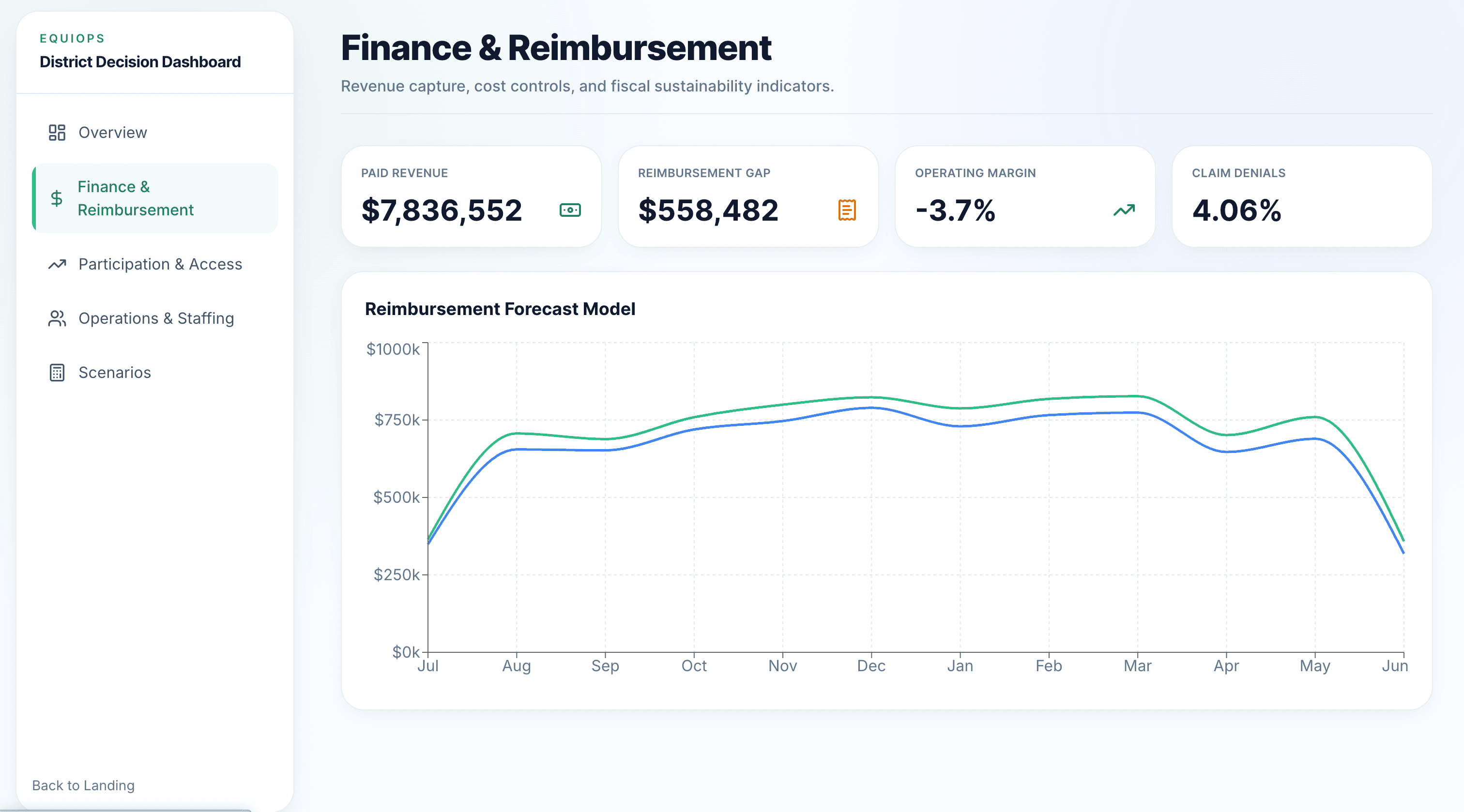
The platform exposed capture behavior alongside participation and site performance, allowing teams to see where process leakage was likely affecting reimbursement outcomes.
Leaders could decide which locations or workflows needed immediate corrective action before claim loss accumulated into a larger financial drag.
Labor Allocation Rebalance
Staffing schedules were not consistently tied to real meal demand or site-specific variability, which led to misallocation and avoidable pressure at the line level.
EquiOps brought labor signals into the same operating view as participation and site demand so teams could see where staffing assumptions diverged from actual conditions.
Operations leaders could rebalance labor coverage by site and shift pattern instead of relying on static schedules that ignored demand reality.
A five-month build from discovery to pilot readiness
The delivery plan was structured as an enterprise program build: define the operating contract, align the data model, ship decision surfaces, add scenario logic, and then harden the trust layer for pilot use.
Discovery and KPI framing
We started with operator interviews, district workflow analysis, KPI definition, and reporting assumptions so the product model would reflect how school nutrition teams actually worked.
Data model and source alignment
The second phase focused on entity mapping, normalization design, ingestion assumptions, and the cross-system operating model needed to connect siloed district data.
Executive and operational dashboard build
We built the first production-grade surfaces for overview, participation, reimbursement, and operations so leaders could move from aggregate reporting into operational diagnosis.
Scenario engine and prioritization logic
Once the operating surfaces were established, we added modeling logic for participation lift, reimbursement recovery, labor heuristics, and intervention prioritization.
Pilot hardening and trust layer
The final phase focused on deployment hardening, security and trust framing, executive-ready narrative polish, and the operational readiness needed for pilot onboarding.
What shaped the build
Decision-centric UX over report-first UX
The product was designed around the decisions district teams needed to make, not around reproducing source-system reports. That forced the interface to prioritize diagnosis, prioritization, and operational next steps over dashboard sprawl.
Explainable formulas over opaque scoring
Scenario outputs had to be interpretable by operators, finance stakeholders, and leadership. The modeling approach emphasized traceable assumptions and understandable formulas instead of black-box scoring that would be hard to defend in district decision-making.
District language shaped the product model
The core data model was influenced as much by operational vocabulary as by schema structure. Participation, capture, site pressure, and intervention prioritization had to map to how district teams already reasoned about the work.
The visible dashboard was only the surface
The screenshots show a polished interface, but the real value came from the operating model underneath it. Without normalized entities and cross-system metric logic, the UI would have remained another attractive but shallow reporting layer.
Trust mattered as much as analytics polish
Education buyers need operational credibility, not just visual polish. Security framing, executive readability, and disciplined presentation of modeled outcomes were part of the product design, not add-ons after the fact.
Results & Impact
Quantified outcomes from the delivered platform.
Tech Stack
“EquiOps gave us a decision system, not another reporting dump. Participation gaps, reimbursement leakage, and staffing pressure finally became visible in one operating language.”